Page Last Updated: May 22, 2026
Data Release Workflows & SOPs🔗
This document outlines the staged workflow for selecting, releasing, and validating data for public dissemination. Key stakeholders include the HCAC Project Manager (PM), HBCD Data Coordinating Center (HDCC), Oversight Group (OG), Workgroups (WGs), and Lasso.
Release Timeline🔗
The release timeline for determination of variables to include in the release, study instrument documentation (or "READMEs" - see details), final QC of data as available via the Lasso Pre-Release System, etc. is as follows:
Release 3.0 Timeline🔗
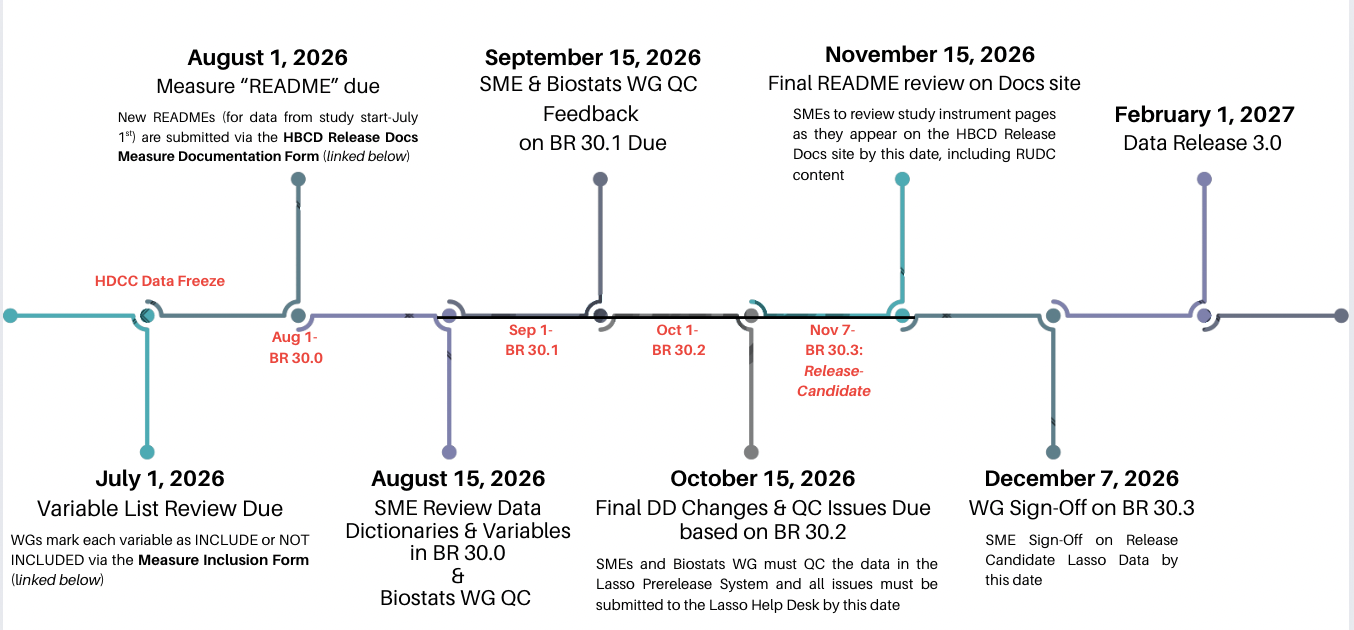
- HBCD Release Docs Measure Documentation Form to submit documentation/"READMEs" for new instruments/measures to be included in a release (see details)
- Measure Inclusion Form tracking the list of variables to be included in upcoming release
- Release Timeline Sign-Off Form
Process for Determination of Release Timeline🔗
The release timeline is determined as follows:
- HDCC proposes a timeline
- HCAC leadership approves proposed timeline
- Program approves proposed timeline
- Feedback is acquired from Workgroups
Stages of the Release Workflow🔗
Stage 1: Determine Variables to Include & Data Filters for Release🔗
Click to learn more Project Management
Click to learn more Timeliness planning
Click to learn more
Variable Inclusion Sign-Off🔗
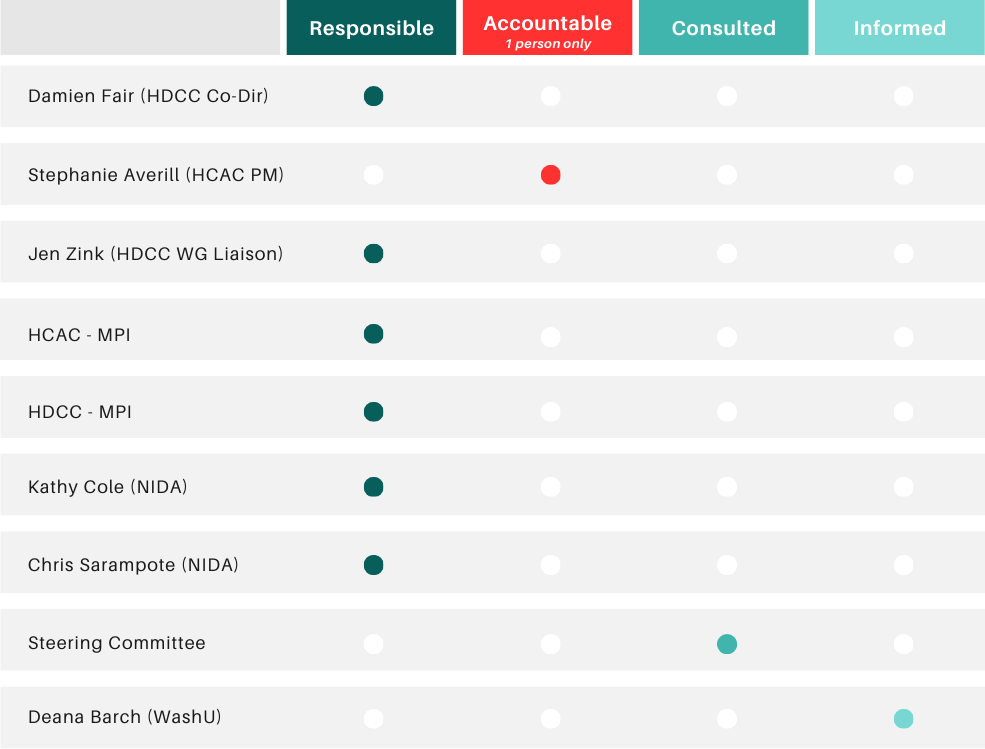
The HCAC PM (Stephanie Averill) collaborates with the HDCC WG Liaison (Jen Zink) to generate a comprehensive list of potential variables for the upcoming data release.
- The full list is circulated to all Workgroups and subject matter experts (SMEs), who mark each variable as INCLUDE or NOT INCLUDED in the Variable Inclusion Form.
- From this list, a Variable Inclusion Sign-Off Form is generated for HDCC/HCAC Leadership to review the proposed measures to be included/excluded from public release.
- Proposed public release measures are then brought to the Steering Committee for final sign-off.
Release measure inclusion sign off RACI:
Data Filters Sign-Off🔗
In addition to deciding which variables to include in the release, the HDCC, HCAC, and Workgroups collaborate to determine general administrative inclusion/exclusion filters (as opposed to specific variable filters, which are tracked elsewhere) to be applied to the data release. This includes, but is not limited to:
- Site exclusions (e.g., Florida)
- Cell size per site
- Cohort (e.g., post-natal recruitment)
- Outlier or "impossible value" removal (yes/no)
- etc.
Data filters applied to Release 1.0 are described in detail on the R1.0 Release Notes under Exclusion Criteria & Filters.
Stage 2: Integrate Planned Measures in Beta Releases🔗
Click to learn more Data quality checks
Click to learn more Project Management
Click to learn more Timeliness planning
Click to learn more
The HDCC implements the measures marked as INCLUDE and begins the first versioned Beta Release (BR) approximately 1–2 months after the data freeze. Note: An updated SOP is under development to address scenarios where a measure is marked as “INCLUDE,” but cannot be implemented during the current release.
Beta Release (BR) Sprint Cycle🔗
- Known issues and new features are prioritized for the sprint.
- Versioned BRs are released on the 4th Friday of every month.
- Each BR is accompanied by a BR Hot Sheet completed by HDCC to guide Lasso ingestion - see Hot Sheet template.
BR Hot Sheet - Key Areas
| Date/Time Confirmation | Specifies when BRX is ready and identifies the single point of contact. |
| Compliance Checklist | Highlights potential issues that could make the data non-compliant (e.g., missing participants in `participant.tsv`) or disrupt loading or downloading. |
| Sign-Off and Documentation | Responsible parties provide a clear/thoughtful review and sign off on the release contents. This includes confirmation that the BR Release Notes are documented under Change Logs in the internal Docs site. |
Lasso Ingestion🔗
Once the BR Hot Sheet is finalized, the HDCC sends it to Lasso to initiate BR ingestion, which includes Lasso ingestion QA. After ingestion is complete, the HDCC liaison (Jen Zink) notifies WGs that data are available in Lasso and requests they complete Quality Control (QC) reviews. Lasso obtains final sign-off from Workgroups on datasets in their release-ready form, with applied filters, via the Lasso Pre-Release System.
Stage 3: Data Quality Issue Identification, Reporting, and Handling🔗
There are 2 bins of issues with separate pipelines for reporting/handling:
Bin 1: Internal Findings🔗
- Identified during Lasso ingestion QA
- Tracked by HDCC on the internal Monday board for resolution
Bin 2: Workgroup Findings🔗
Issues identified by WGs, analysts, or via LORIS, reported in collaboration with the HDCC liaison (Jen Zink). These issues are logged in a structured format for BR sprint planning and resolution by HDCC. Once Bin 2 issues are added to an upcoming BR sprint and the corrections appear in a versioned BR in Lasso, Jen communicates to original reporter that the known issue is addressed and verifies the correction is implemented as expected in the Lasso system.
WG Template for Reporting Issues🔗
| Issue Category | Data Error, Data Improvement, Data Dictionary Request |
| Data Element/Instrument Affected | Element/instrument name |
| Description | Explanation of issue |
| Proposed Fix | Description of fix |
| Reporter | SME/analyst name and contact info |
Stage 4: Data Sign-off and Public Release🔗
Click to learn more Data quality checks
Click to learn more Transparency
Click to learn more
When the the second-to-last BR prior to Public Release is loaded in Lasso, the HDCC liaison (Jen Zink) schedules one-on-one sign-off meetings with all WG chairs/SMEs who have measures in the planned release for final QC/review in Lasso. Prior to these meetings, WG chairs/SMEs have pre-QC’ed their data in the latest BR. During these meetings, Jen reviews:
- Past QC items that have been identified and corrected in previous BRs
- Any further QC action-items to be addressed prior to public release (if applicable) based on WG/SME review of the latest BR and items identified by Jen
During the one-on-one sign-off meetings, if no further action-items are found by either the WG/SMEs or Jen, the WGs/SMEs sign off on their measures via this sign-off sheet template.
If further QC action-items are found in the second-to-last BR during the one-on-one sign-off meetings, the WG/SMEs do NOT sign off on their measures. Jen communicates the data issues back to the HDCC via the centralized Monday Board, so the remaining items can be prioritized for the final BR prior to public release.
When the final BR prior to public release is loaded into Lasso, Jen schedules one-on-one sign-off meetings with the remaining WGs/SMEs who were awaiting corrections to their data prior to sign off. During these meetings, Jen reviews the list of items that were identified in the last round of QC with the WGs/SMEs to ensure the correction is implemented as expected in the Lasso; the WGs/SMEs then sign off on their measures via the same google form above.
In the event that data issues remain, or new issues are identified in QC of the final BR during the one-on-one sign-off meetings, Jen collaborates with the WGs/SMEs and Luci Moore to document these as ‘Known Issues’ for the Data Release Documentation site. Jen reports the known issues on the HDCC centralized Monday Board so they can be prioritized for the Patch Release.
Patch Releases🔗
Patch releases occur only to address “Known Issues” in the current public data release; they are not intended for releasing additional sessions/visits, protocol elements, or participants. Known issues are either identified via the HDCC, WGs/SMEs, or the scientific community (users of the public release data via the Lasso ticketing system). Once they are identified and reported to HDCC, they are then placed on the centralized Monday Board for prioritization.
When known issues are addressed, HDCC sends samples of the corrected data to the respective WGs/SMEs for their confirmation. Once the data fixes are confirmed by SMEs, the corrected data elements are then ingested into the Lasso QC environment (where the BRs are QCed). Jen further QC’s the data in the Lasso environment to ensure all fixes are implemented appropriately and schedules one-on-one sign-off meetings with each WG with a measure in the patch release.
During these sign off meetings, the following is covered:
- The WG confirmation the data issues are addressed (in Lasso)
- Jen confirmation the data issues are addressed (in Lasso)
- WG sign-off (via google form)
Approved Updates to Future Releases🔗
See the approved updates to release 2.0 in the Release Notes on the HBCD Data Release Docs site: Release 2.0 (Release Date TBA).
Responsibility Assignment Matrices🔗
Below we outline the individuals responsible for various stages of the release across data modalities via RACI matrices, which outline the following:
| Meaning | Definition | |
|---|---|---|
| R | Responsible | Individual doing a piece of the work to complete this task. |
| A | Accountable | 1 person only who is ultimately answerable for the correct and thorough completion of the deliverable or task. |
| C | Consulted | People who provide input or advice before the work is done. |
| I | Informed | People who need to be kept updated on progress or decisions, but do not need to be consulted or perform tasks. |
Note that items outlined below pertain specifically to the data release stage. Responsibility matrices for general processing and quality control stages can be found on under Data Processing Workflows (see RACIs for tabulated data and file-based data by modality).
🚧 UNDER CONSTRUCTION 🚧
| Study Stage | Step | Location | Responsible | Accountable | CConsulted/IInformed |
|---|---|---|---|---|---|
| Pre-Release Prep | Generate Release Candidate IDs for Public Release | UMN HST | Reed McEwan | Reed McEwan | -/- |
| Data QC | Review of Dashboards and Completeness | LORISLassoRippleHCAC | Santiago Torres (LORIS), Jen Zink (Lasso), Sauren Ravencroft (Ripple), Stephanie Averill (HCAC) | WG Leads | -/- |
| Pre-Release | Sign Off on Release Candidate | Lasso | Jen Zink, WG Leads | Damien Fair | -/- |
| Study Stage | Step | Location | Responsible | Accountable | CConsulted/IInformed |
|---|---|---|---|---|---|
| Pre-Release Prep | Determine Release Candidate and Process with Sign Off | WashU | MRI WGs, Eric Feczko, Jen Zink | Chris Smyser | -/- |
| Data Process | De-identification of BIDS data | UMN MSI | Sriharshitha Anuganti | Sriharshitha Anuganti | -/- |
| Data Process | Run processing pipelines | UMN MSI | CBRAIN | Erik Lee | [C] WG SMEsWorkgroup Subject Matter Experts |
| Data Process | Transfer derivativesprocessed pipeline outputs to LORIS, re-inserting DCCIDs | UMN MSI | Harshitha Anuganti, Erik Lee, Tim Hendrickson, Jesse Erdmann | Harshitha Anuganti | -/- |
| Data Process | Ingest derivatives into LORIS and create tabulated imaging files | UMN MSI | Cecile Madjar, Santiago Torres, Samir Das | Cecile Madjar | -/- |
| Data QC + Action | Post-processing QC (Manual & Automated) | CDNI (UMN) | Michael Anderson | Eric Feczko | [C] Lucille Moore [I] Damien Fair |
| Data Process | Move source BIDS to platform | UMN MSI | Erik Lee, Tim Hendrickson, Data Loading Team (Lasso) | Erik Lee | -/- |
| Data Process | Move BIDS phenotype files to platform | UMN MSI | Harshitha Anuganti, Erik Lee, Tim Hendrickson, Jesse Erdmann, Data Loading Team (Lasso) | Harshitha Anuganti | -/- |
| Data Process | Move raw BIDS and derivatives to platform | UMN MSI | Erik Lee, Tim Hendrickson | Erik Lee | -/- |
| Data QC + Action | SMEs review data | Various | MRI WG SMEsWorkgroup Subject Matter Experts, Jen Zink | Eric Feczko | -/- |
| Data QC + Action | Data corrections | Various | Erik Feczko, Jen Zink, Erik Lee, Tim Hendrickson | Erik Lee | -/- |
| Documentation of Processes | Documentation of processes, known issues, etc. | UMN MSI CDNI |
MRI WG SMEsWorkgroup Subject Matter Experts, HDCC | Lucille Moore | -/- |
| Sign Off | SMEs sign off on data | Lasso | Jen Zink, Eric Feczko | Jen Zink | -/- |
| Study Stage Step | Location | Responsible | Accountable | CConsulted/IInformed |
|---|---|---|---|---|
| Pre-Release Prep: Determine Release Candidate and Process with Sign Off | UMD EEG Core | Santiago Morales, EEG WG | Nathan Fox | [I] Program |
| QC Pre-release data | UMD EEG Core | Santiago Morales | Nathan Fox | [I] Program |
| Study Stage Step | Location | Responsible | Accountable | CConsulted/IInformed |
|---|---|---|---|---|
| Pre-Release Prep: Determine Release Candidate and Process with Sign Off | -/- | |||
| QC of analysis of sample | Gretchen Bandoli | -/- | ||
| QC of data acquisition | Elinor Sullivan (Co-Chair) | -/- | ||
| QC of analysis | Gretchen Bandoli | -/- | ||
| QC & sign off for prerelease data | Lasso | Workgroup SMEs | Jen Zink | -/- |
| Study Stage Step | Location | Responsible | Accountable | CConsulted/IInformed |
|---|---|---|---|---|
| Pre-Release Prep: Determine Release Candidate and Process with Sign Off | ||||
| QC Pre-release data |
Release Management & Utilities🔗
Data Management & Release Meetings🔗
There are several regular calls where release action items are discussed and tracked:
| Meeting (agenda/notes linked) | Meeting Facilitator | Stakeholders Present |
|---|---|---|
| HDCC Data Release WG Primary meeting dedicated to discussion of data release items Mondays 11 AM CT |
Maren Macgregor-Hannah | UMNLORISLasso |
| HBCD Workgroup calls (action items track onMonday.com) Time/day varies |
First 10 min of WG calls are dedicated to discussing QC and data releases, facilitated by Jen Zink | HBCD WorkgroupsLasso |
| MRI QC Wednesdays 4 PM CT (biweekly) |
Don Hagler | LORIS JCVI HST MIDB |
| ABCD-HBCD Release Tuesdays 10 AM CT |
Deanna Barch | ABCD team (JCVI)UMNLORISLasso |
| ABCD-HBCD Sync Thursday 2 PM CT (Biweekly) |
Janosch Linkersdoerfer | ABCD team (JCVI)UMNLORIS |
| HDCC Architecture & Implementation Tuesdays 3:30 PM CT |
Maren Macgregor-Hannah | UMNLORISLassoWashUJCVI |
| HBCD LORIS Implementation Wednesdays 1:30 PM CT |
Maren Macgregor-Hannah | UMNLORISLasso |
| HDCC IT Workgroup Call EEG, Biospecimens, and other Workgroups can use this time to review IT needs that sometimes pertain to the release Fridays 3 PM CT |
Maren Macgregor-Hannah | LassoLORISJCVIUMDLIBR |
| HDCC/HCAC Biweekly Calls Friday 2 PM CT (biweekly) |
Site monitors | HCACUMNWashU |
| EMR Mondays 4 PM CT (biweekly) |
Nicole Venteris | HST HBCD Workgroup LIBR |
| NIH-BTB Wednesday 11 AM CT (monthly) |
Maren Macgregor-Hannah | LORIS HST HBCD Workgroup App Devs |
Project Management Utilities🔗
| Platform | Use Case(s) |
|---|---|
| Monday.com board | Tracking release actions items |
| Confluence | Storage of all internal documentation and protocols |
| AirTable | Document current protocol, change requests (REDCap or Responsible Conduct request modifications), IRB approvals, initial list of included measures in data releases, QC pages, SC approval, etc. Also used to keep track of staff member item-level access to different working platforms and related required paperworks. |
| Slack | Team and topic-specific communication/coordination |
| HBCD DCC Internal Docs (this site) | Organized, curated, and centralized internal documentation |
| Google Docs | Meeting agendas/notes; holds historical documentation of workflows, context of decision-making, etc. |